Join my middle school French students in agreeing that both this French 3 star hotel with its $21 per day fee and the Dearborn, Michigan Hyatt Regency, with its 50 cents a minute for Wi-Fi on top of $125 a day for the room is EXCESSIVE. Especially when the local bar down the street has free unlimited access. Check it out:
Wi-Fi et petits déj' dans les hôtels
LE MONDE 22.03.08 12h44 • Mis à jour le 22.03.08 14h56
A l'hôtel, les prix des connexions Internet et des petits déjeuners demeurent souvent excessifs, déplorent les clients. Les hôteliers, tant indépendants que membres d'une chaîne, considèrent qu'ils s'adaptent progressivement à la demande.
En voyage professionnel à Biarritz, Macha pensait utiliser son ordinateur portable pour se connecter à Internet et consulter son courrier électronique. En s'adressant à la réception de son hôtel, un classique trois-étoiles, elle a constaté avec surprise que la connexion Wi-Fi (sans fil) lui serait facturée 14 euros les vingt-quatre heures. "On m'a vendu une carte qu'il fallait gratter pour lire une suite de chiffres à saisir sur l'ordinateur", raconte-t-elle. Les prix des connexions sont parfois beaucoup plus élevés. Ils varient surtout énormément en fonction des hôtels, enclins à profiter d'une clientèle captive.
Pour Mark Watkins, président du cabinet de conseil Coach Omnium, spécialisé dans l'hôtellerie, le prix des connexions fait partie des récriminations des clients, comme le fut, avant l'avènement des mobiles, le coût des appels téléphoniques passés de la chambre. "Aujourd'hui, il est difficile d'admettre de payer l'accès au Wi-Fi alors que l'on peut se connecter gratuitement dans bon nombre de lieux publics", observe-t-il.
Certains clients, souvent en déplacement, ont définitivement réglé le problème en s'équipant d'un terminal Internet mobile ou en se connectant à partir de leur téléphone. Les hôteliers semblent prendre lentement conscience des changements de comportement. "14 euros par jour pour une connexion Wi-Fi dans un contexte de concurrence entre établissements, c'est à éviter", reconnaît le vice-président de l'Union des métiers de l'industrie hôtelière (UMIH), Roland Héguy.
Certains hôtels s'adaptent. Les 200 établissements de la chaîne B & B Hôtels proposent ainsi, avec le prix de la chambre, un accès Wi-Fi illimité. A partir du 1er janvier 2009, Best Western généralisera, dans ses 280 hôtels français, l'Internet gratuit. Une mesure déjà en vigueur dans ses établissements américains. "L'abonnement ne coûte à l'hôtelier que 30 euros par mois, il n'est pas acceptable qu'il soit revendu très cher au client", explique Stéphane Gauthier, directeur général de Best Western France.
La marque All Seasons, propriété du groupe Accor, a pour sa part développé pour sa vingtaine d'hôtels un concept "tout compris" incluant, pour 70 euros la chambre double, le Wi-Fi, huit chaînes de télévision et la consultation d'un panel de journaux. Dans les établissements Suite Hôtels, l'accès Wi-Fi est payant en chambre mais gratuit à la réception. Cette politique de gratuité ne concerne pas encore les autres marques du groupe hôtelier.
Les griefs des clients concernent aussi le coût du petit-déjeuner, qui atteint souvent 10 % du prix de la chambre. "Contrairement à Internet, cette prestation dépend directement de l'hôtelier, qui en fixe lui-même le prix. Or, depuis quinze ans, l'offre ne s'est pas améliorée, même dans les chaînes", estime M. Watkins.
En Allemagne ou au Royaume-Uni, le premier repas de la journée, toujours copieux, est généralement inclus dans la location de la chambre. M. Héguy met en avant les contraintes de la profession. "L'organisation du petit-déjeuner est aussi compliquée que celle du repas de midi. Le service s'étend de 7 heures à 10 heures, mobilise de nombreux salariés et des moyens matériels importants, à commencer par le linge", observe-t-il. "L'explication est comptable, avance de son côté le responsable de l'UMIH. Le taux de TVA de l'hôtellerie est fixé à 19,6 % et celui de la restauration à 5,5 %. Les propriétaires préfèrent différencier les comptes."
Les entreprises hôtelières assurent pour leur part que le service a récemment évolué. "Pour 7 euros à 15 euros", le client accède à un buffet "exhaustif et de qualité", promet M. Gauthier, chez Best Western. "Il peut aussi disposer d'un "plateau de courtoisie", composé d'une bouilloire électrique et de sachets de thé et de café", ajoute-t-il.
Reste au client, confronté à un petit-déjeuner cher et fade, la possibilité de "snober" son hôtel et de préférer le café-croissant pris à la terrasse d'un bar de la ville.
Olivier Razemon
Article paru dans l'édition du 23.03.08.Abonnez-vous au Monde à -60%
Tuesday, March 25, 2008


Bell-ringer Reading
In case any of you bloggers are in need of erudite clarity on the strategy of authentic document reading to open the language study classroom, I'm posting my paper on the topic that was recently published in the Central States Conference Journal. Bring a shovel.
Abstract
Bell-ringer reading offers a reading activity in the target language to open the class period. Students engage in individual silent reading of an authentic text followed by brief partnered collaborative and class discussion. Bellringer reading permits teacher modeling and student practice of various reading strategies, brings current culture into the classroom, provides contextualized study of language structure, and engages student interest.
Which student learns more successfully, the one who skips into the classroom with a sparkle saying confidently, “I can do this!” or the one who drags in with a sigh and the eye-roll that expresses all the despair of anticipated failure? It seems to me as a veteran teacher that the foundation of learning rests on an attitude of confidence in anticipated success, a sense of competence. Without the possibility of success, there is little motivation to persevere (Stiggins, 1999). How can we start the day in such a way as to maximize the positive?
I begin each class with an activity that I call bellringer reading to offer the students a boost to their sense of accomplishment, a connection to current events that interest them, and an authentic context in which to examine language. I use a document camera to project an online French newspaper article on the classroom screen, but a teacher could instead use overhead transparencies, photocopies, or authentic documents to provide this reading activity. I am finding that although my original purpose was to provide meaningful instruction in French, bellringer reading is an investment in the overall success of my students as readers and learners. The larger benefits reflect the improvements that are delivered by increased confidence and the use of metacognitive strategies in diverse learning situations.
I propose to describe this classroom practice that seems to offer many benefits to my middle school French students, benefits in their language learning, in their attitude, and in their reading strategies. Following a review of current literature that supports this classroom activity, I will describe bellringer reading in the classroom and consider the perceived benefits.
Research Backdrop
My decision to engage in daily bellringer reading is based on what Francis Mangubhai (2006) calls “personal practical theories” (page 1), but significant research supports my observations. Pressley’s (2000) summary of what makes a good reader points the way to significant topics of interest: “Good readers are aware of why they are reading a text, gain an overview of the text before reading, make predictions about the upcoming text, read selectively based on their overview, associate ideas in text to what they already know, note whether their predictions and expectations about text content are being met, revise their prior knowledge when compelling new ideas conflicting with prior knowledge are encountered, figure out the meanings of unfamiliar vocabulary based on context clues…, interpret the text, evaluate its quality, review important points as they conclude reading, and think about how ideas encountered in the text might be used in the future” (Active Comprehension Strategies, para.1). Perencevich (2004) states that “outstanding reading teachers provided academically rich and connected activities, taught reading strategies, and offered a variety of challenging texts” (page 5). All of these reading tasks can be accomplished in bellringer reading, with the larger benefit of increased student self-confidence and metacognitive strategies useful in problem-solving tasks other than reading. I will review the literature in the areas of motivation and engagement, use of bellringers, the importance of reading in the target language, contextualized learning, difficulty level of texts, modeling metacognition, impact of self-confidence, and addressing culture standards.
Abstract
Bell-ringer reading offers a reading activity in the target language to open the class period. Students engage in individual silent reading of an authentic text followed by brief partnered collaborative and class discussion. Bellringer reading permits teacher modeling and student practice of various reading strategies, brings current culture into the classroom, provides contextualized study of language structure, and engages student interest.
Bellringer reading
Which student learns more successfully, the one who skips into the classroom with a sparkle saying confidently, “I can do this!” or the one who drags in with a sigh and the eye-roll that expresses all the despair of anticipated failure? It seems to me as a veteran teacher that the foundation of learning rests on an attitude of confidence in anticipated success, a sense of competence. Without the possibility of success, there is little motivation to persevere (Stiggins, 1999). How can we start the day in such a way as to maximize the positive?
I begin each class with an activity that I call bellringer reading to offer the students a boost to their sense of accomplishment, a connection to current events that interest them, and an authentic context in which to examine language. I use a document camera to project an online French newspaper article on the classroom screen, but a teacher could instead use overhead transparencies, photocopies, or authentic documents to provide this reading activity. I am finding that although my original purpose was to provide meaningful instruction in French, bellringer reading is an investment in the overall success of my students as readers and learners. The larger benefits reflect the improvements that are delivered by increased confidence and the use of metacognitive strategies in diverse learning situations.
I propose to describe this classroom practice that seems to offer many benefits to my middle school French students, benefits in their language learning, in their attitude, and in their reading strategies. Following a review of current literature that supports this classroom activity, I will describe bellringer reading in the classroom and consider the perceived benefits.
Research Backdrop
My decision to engage in daily bellringer reading is based on what Francis Mangubhai (2006) calls “personal practical theories” (page 1), but significant research supports my observations. Pressley’s (2000) summary of what makes a good reader points the way to significant topics of interest: “Good readers are aware of why they are reading a text, gain an overview of the text before reading, make predictions about the upcoming text, read selectively based on their overview, associate ideas in text to what they already know, note whether their predictions and expectations about text content are being met, revise their prior knowledge when compelling new ideas conflicting with prior knowledge are encountered, figure out the meanings of unfamiliar vocabulary based on context clues…, interpret the text, evaluate its quality, review important points as they conclude reading, and think about how ideas encountered in the text might be used in the future” (Active Comprehension Strategies, para.1). Perencevich (2004) states that “outstanding reading teachers provided academically rich and connected activities, taught reading strategies, and offered a variety of challenging texts” (page 5). All of these reading tasks can be accomplished in bellringer reading, with the larger benefit of increased student self-confidence and metacognitive strategies useful in problem-solving tasks other than reading. I will review the literature in the areas of motivation and engagement, use of bellringers, the importance of reading in the target language, contextualized learning, difficulty level of texts, modeling metacognition, impact of self-confidence, and addressing culture standards.
Motivation
According to Guthrie (2000), “engaged reading is a merger of motivation and thoughtfulness. Engaged readers seek to understand; they enjoy learning and they believe in their reading abilities. Classroom contexts can promote engaged reading. Teachers create contexts for engagement when they provide prominent knowledge goals, real-world connections to reading, meaningful choices about what, when, and how to read, and interesting texts that are familiar, vivid, important, and relevant. Teachers can further engagement by teaching reading strategies. A coherent classroom fuses these qualities” (Overview section, para.1). What is the value of engaging readers? “In cross-age comparisons, 13-year-old students with higher reading engagement achieved at a higher level than did less engaged 17-year-old students. Engagement in reading can also compensate for low achievement attributed to low family income and educational background. In the same national data, engaged readers from low income/education families achieved at a higher level than did less engaged readers from high income/education backgrounds. Engaged readers can overcome obstacles to achievement and become agents of their own reading growth” (Guthrie, Schafer, & Huang, 2001). Guthrie (2000) discusses three aspects of motivation: performance, which focuses the reader on achieving praise, task mastery, which focuses more intrinsically on accepting a challenge and learning new skills, and self-efficacy, which focuses on the reader’s judgment of his own abilities (Motivation research section, para.1). Citing Eccles, Wigfield, & Schiefele(1998) and Eccles & Pintrich (1996), Guthrie (2000) notes that “practices that focus on social comparison betweenchildren, too much competition, and little attempt to spark children’s interests in different topics can lead to declinesin competence beliefs, mastery goals, and intrinsic motivation, and increases in extrinsic motivation and performance goals” (Motivation research, para.6). To work to prevent the decline in reading motivation of middle school students cited by Guthrie, we must encourage collaborative reading that addresses diverse interests and builds an attitude of anticipated daily success for each student. Guthrie also notes that there is a difference between motivation and attitude or interest. A highly motivated reader may not like reading certain topics or may not like to read at all (Motivation research section, para.8). “Students who were … dedicated to understanding content, using strategies effectively, and linking their new knowledge to previous experiences -- were likely to be more highly engaged than other students” (Guthrie, 2000,Learning and knowledge goals section, para.1). The value of teacher recognition for student success is a means to increase student motivation. “When praise is sincerely given and interpreted as recognition of achievement, it can increase students’ self-perceived competence and motivation” (Guthrie, 2000, Praise and rewards section, para.2). Guthrie concludes that “teachers who aspire to increase engaged reading in the classroom can do so by building a context for it. To create this context teachers can
• Identify a knowledge goal and announce it
• Provide a brief real-world experience related to the goal
• Teach cognitive strategies that empower students to succeed in reading these texts
• Assure social collaboration for learning
• Align evaluation of student work with the instructional context (e.g., grade students for progress toward the knowledge goal)” (Guthrie, 2000, conclusion).
Bean discusses the readers’ perceived connection to the topic and the chance to collaboratively discuss the topic as sources of motivation. “Adolescents are likely to be motivated to read when the nature of the material they read connects with their lives and when they have opportunities for discussion” (Bean, 2000, Attitudes section, para.2).
Use of bellringers
I have used a bellringer of some kind in all my classes because an anticipatory set engages the attention of students. The purpose is to involve all students and focus attention, “to initially focus learner attention on a problem in a way that captures their interest” (Magruder, 2007, Definition). “Some teachers have found that turning the lights down low and projecting the morning's bell ringer activity onto the chalkboard with an overhead projector helps focus students' attention on the day ahead. Such ‘bellringer’ activities get the day off to a purposeful start by focusing kids' energies and attention” (Starr, 2006, Calm down, para.1). An anticipatory set, or bellringer, is a recommended opening to a lesson, which aims to “provide a brief practice and/or develop a readiness for the instruction that will follow” (Combs, 2007, para.2).
Input, input, input
Mangubhai (2007) states that extensive input in the second language improves learning dramatically.
Some evidence for this comes from the early work of Elley and Mangubhai (1983)
where children (10-12 years old) learning English as a second language (in a foreign
language-like context) were provided with extensive input ("Book Flood") in
English through regular reading (20-30 minutes) in the classroom. These children
outperformed the control group who did not have this printed input but continued
with their structural program for the same duration. The superior language development
through extensive reading has been labelled "acquisition" by Krashen (1993b).
Further examples of acquisition through reading have been documented in Elley
(1991) and Krashen (Krashen, 1993a; 1993b) (page 1).
The Mangubhai study involves much longer reading time than my bellringer reading activity, but our daily reading of authentic language provides a regular practice of this important activity, establishing a habit. Mangubhai concludes that “to become fluent in a language, one must receive extensive L2 input. Research suggests that language learning occurs best when learners are engaged in communicative acts (Lightbown & Spada, 1999), or to put it in another way, when learners are engaged in encoding and decoding meanings in acts of communication (oral or printed)… In other words, teachers should have dinning through their head the word 'input', 'input', 'input’”(Mangubhai, 2006, Insight #5).
The National Council of Teachers of English SLATE fact sheet citing Elley (1991) and Krashen (1993) notes that “research suggests that extensive reading may promote the acquisition of grammatical structures better than explicitly studying or practicing such structures Indeed, for both first and second language learners, extensive reading significantly promotes grammatical fluency and a command of the syntactic resources of the language” (NCTE SLATE fact sheet, n.d., What works better section, para.5). Students find the bellringer reading more like leisure reading than assigned textbook content reading since there is no comprehension testing. There is ample evidence that reading outside the formal reading sphere boosts vocabulary acquisition (Iyengar & Bauerlein, 2007). They state that “while school reading programs peddle their rival curricula, cognitive scientists are busy proving that informal exposure to language—through heavy doses of leisure reading—can influence a child’s vocabulary growth far more than classroom training” (Iyengar & Bauerlein, 2007, para.10).
Contextualized learning
Mangubhai (2007) also reinforces my sense that a vocabulary word, a grammar point, or an idiom that we encounter in our brief reading allows me to teach or reinforce language structure when the students are open and interested in learning it for the purpose at hand, which is far more effective than when the grammar or linguistic structure is addressed in isolation. He discusses the learner trait of noticing, making reference to the work of Schmidt.
A quick lesson on the correct form at that particular instance when students need the form might lead to a greater amount of noticing between what their current knowledge is and where they need to be in order to communicate with grammatical accuracy. (Mangubhai, 2007, page 1)
The National Council Teachers of English position paper on grammar exercises states that “ample evidence from 50 years of research has shown the teaching of grammar in isolation does not lead to improvement in students' speaking and writing, and that in fact, it hinders development of students' oral and written language” (NCTE, 2007, Background section). The Nebraska Institute for the Study of Adult Literacy (1993) states that “contextualized learning is nothing new. It is based on the proposition that people learn more effectively when they are learning about something that they are interested in, that they already know something about, and that affords them the opportunity to use what they already know to figure out new things. It is similar to a fairly common approach in reading instruction which emphasizes the value of prior knowledge in enabling readers to make sense of what they read” (Nebraska Institute, 1993, para. 2).
Difficulty level of text
The choice of a real time online French newspaper as the daily reading text for middle schoolers with no previous target language learning may seem to be overly difficult and likely to thus discourage even the most able. Mangubhai (2007) addresses this concern by reminding us that comprehension far outstrips production. He supports the use of materials “that may, on the surface, appear quite difficult for the learners but which may still be understood, provided, that the activity or activities associated with such use do not expect learners to get detailed meanings of the text, but rather the gist of what has been heard or read” (page 1).
Pressley (2000) notes “that children do develop knowledge of vocabulary through incidental contact with new words they read is one of the many reasons to encourage students to read extensively. Whenever researchers have looked, they have found vocabulary increases as a function of children’s reading of text rich in new words” (Pressley, 2000, Vocabulary section, para. 3).
Pressley (2000) notes “that children do develop knowledge of vocabulary through incidental contact with new words they read is one of the many reasons to encourage students to read extensively. Whenever researchers have looked, they have found vocabulary increases as a function of children’s reading of text rich in new words” (Pressley, 2000, Vocabulary section, para. 3).
Modeling strategies of metacognition
Students read “to make sense of the world around them” (Harvey, Goudvis, & Graves, 2007, page xv). As teachers we need to show students how to read, rather than simply telling them, modeling reading strategies (Harvey et al, pages 46-52). Bellringer reading provides a dynamic forum for modeling reading strategies and the inner voice that interacts with the text during reading, strategies that are useful in diverse reading contexts beyond the target language classroom, metacognitive strategies that are, in fact, useful in wider learning contexts other than reading.
Zakin (2007)addresses the process of teacher modeling and the acquisition of strategies for student metacognition as well.
“Metacognitive instruction predicated on inner speech differs from typical good teaching practice in its systematic reliance on inner speech. The “ARE” approach maintains that the steps for thinking through a problem need to be made as explicit as possible for students to identify the problem, brainstorm and select best approaches, avoid errors typically made by the individual, and evaluate their process and progress. The approach is dependent on teacher modeling and incremental scaffolding of students’ work process. While the goal of this pedagogical approach is automatic inner speech-facilitated problem solving, it emphasizes process over product, and accordingly takes into account each step of the learning process and the student’s pace of learning. (p.4).
DeLaO (2001) cites the work of Chamot and O’Malley, explaining “that learners that are engaged in organizing new information into existing schemata create more channels for comprehension and recall versus students who simply memorize new information; these metacognitive strategies can be taught and through meaningful practice students can propel their learning; this new repertoire of learning strategies, once internalized, can be generalized and applied to new academic tasks; and students learn academic language easier via learning strategies (Chamot & O’Malley, 1994)” (para. 8). “The development of metacognition appears to be linked to proficiency in learning” (Collins, 1994, para.17). As the classroom application of bellringer reading will demonstrate, this short reading activity allows the classroom teacher to engage students in the development of metacognitive strategies to improve their target language reading skills and to apply metacognitive strategies to other learning tasks.
Guthrie (2000) notes that “strategy instruction involves the explicit teaching of behaviors that enable students to acquire relevant knowledge from text. Explicit instruction includes teacher modeling, scaffolding, and coaching, with direct explanation for why strategies are valuable and how and when to use them. In the domain of reading, students are given a sense of self-perceived competence when they are taught strategies for learning from text” (Strategy instruction section, para.1).
Pressley (2000) emphasizes the value of modeling when he advises that “Teachers should model and explain comprehension strategies, have their students practice using such strategies with teacher support, and let students know they are expected to continue using the strategies when reading on their own. Such teaching should occur across every school day, for as long as required to get all readers using the strategies independently -- which means including it in reading instruction for years” (Active comprehension strategies, para.4).
Impact of self-confidence on learning
As Stiggins (1999) reminds us, “Students succeed academically only if they want to succeed and feel capable of doing so. If they lack either desire or confidence, they will not be successful. Therefore, the essential question is a dual one: How do we help our students want to learn and feel capable of learning?”(p. 1). Wang (2007) offers support for this contention when she includes student attitude toward the subject as a category of influence on academic learning (category 4). The application of bellringer reading activities can provide a springboard to improving and supporting student self-confidence.
Citing Vroom (1964), Huitt (2001) explains that expectancy theory proposes the following equation: motivation equals the result of multiplying Perceived Probability of Success (Expectancy), Connection of Success and Reward (Instrumentality), and Value of Obtaining Goal (Valance, Value). Since Expectancy, Instrumentality, and Value are multiplied by each other, a low value in one results in low motivation, so all are vital for motivation. If students don't believe they have a possibility of success, if they don’t see a connection between their effort and success, if they don’t value the results of success, then they probably will not persevere in the activity “All three variables must be high in order for motivation and the resulting behavior to be high” (Cognitive section, para. 5). “Franken (1994) states that ‘there is a great deal of research which shows that the self-concept is, perhaps, the basis for all motivated behavior. It is the self-concept that gives rise to possible selves, and it is possible selves that create the motivation for behavior’ (p. 443)” (Huitt, 2004, para.3).
Oldfather (1993) studied the consequences of students’ lack of success. She reports: “Marcel, a fifth grade student who participated in an interpretive study of student motivation, described how he felt when he was not able to do an assignment:
Just my whole body feels like I want to throw up or something,
if I don't like something....I can't do it at all....I feel like sick,
and I feel so sick....My body feels completely wrong.
This paper offers the perspectives of Marcel and his classmates on their experiences when they did not feel motivated for academic tasks. Their views provide insights about the social, affective, and cognitive processes that may enable some children to become engaged in literacy activities, and prevent others from even beginning those activities” (page 1).
Guthrie (2000) notes that “fundamental to most theories of intrinsically motivated learning is self-perceived competence” (Strategy instruction section, para.1). Bellringer reading of authentic documents can be a means to address the need to provide opportunities for students to improve their self-perception as readers and as learners in general with the goal of increased engagement and motivation. This increased engagement and motivation in turn benefits reading success.
Addressing culture standards
The National Network of Early Language Learning journal Learning Languages (2006) addresses the importance of the World Language standards of teaching culture. “In June 2001, Asia Society's National Commission on Asia in the Schools released its report which concluded that ‘young Americans are dangerously uninformed about international matters’ (National Commission on Asia in the Schools, 2001, p. 6). Since then, Asia Society has been leading a major national initiative to stimulate teaching and learning about the history, geography, cultures, and languages of Asia and other world regions in America's schools. In this article we explore the crucial relationship between the early language classroom and the international knowledge and skills that are so vital in the 21st century” (Stewart and Singmaster, 2006, para.1).
Collaboration
Guthrie (2000) refers to collaboration as “the social discourse among students in a learning community that enables them to see perspectives and to construct knowledge socially from text. Many teachers use collaboration to activate and maintain students’ intrinsic motivation and mastery goal orientation” (Collaboration section, para.1). Citing Harmer (1998) and Nielson (1989), Baker (2007) concludes that students in collaborative discussion have increased talking time, benefit from exchanging strategies with others with different learning styles, and increase the development of individual thinking. (para. 2).
Bellringer reading in Practice
Bellringer reading
In my French classroom of sixth, seventh, and eighth graders, each class begins with a minute or two of individual reading of a current news article. Students know that when they come in, they will see an online newspaper article projected onto the screen. A classroom without access to that technology could use an overhead transparency of a printed article, a printed copy of a news article that students pick up when they enter, or an authentic document other than the news. My students’ task is to identify the topic and at least three words they recognize either as cognates or from experience in French and to note questions that they ask while reading. I challenge them to read enough to be able to engage in a discussion of the topic, in English. During these few minutes they are immersing themselves in French while I take attendance.
Reading Response
After a minute or so of reading, I ask students to turn to a partner or a small group to share their observations and respond to the reading. In a class discussion that ranges from 1 to 5 minutes following the individual reading and sharing time, we address the questions that they raised, discuss the implications of the topic, or note interesting language structures. The discussion varies from one class to the next and will often raise different language questions in each class.
Paired Collaborative Sharing
After a short individual reading, students are instructed to discuss with a seat partner what they have read. I specifically instruct them to summarize, question, observe, predict, and infer. As I move among them I frequently hear conversations asking for the meaning of a key word, observations of language structures recently studied, and invariably the eager hands in the air squealing, “I know! I know!” This talk time gives me a chance to interact and to listen, to compliment and to reassure. This brief buzz time generally sees all students engaged in conversation.
Class Discussion
I call the class to attention after a short opportunity to share and ask for their questions and observations. One class might debate whether the topic of an article was Sports or the Rugby World Cup, so we take the opportunity to note the difference between a general topic and a detailed focus. Since the World Cup was being played in France that month, the sports fans enthusiastic about this discussion found a personal connection to French. By purposefully choosing a revolving variety of topics, different students have prior knowledge to share and interest in the article. We have discussed the changing school calendar in France, the proposed addition of extracurricular activities for latch-key kids, and the California forest fires, riots in the Parisian suburbs, fishermen and student strikes, and the World Cup of Handball, all in the context of the day’s front page article.
Cognate recognition
Another class might share key words that they identify as they summarize the article. There is regular exultation at the success that they have in deciphering this new language to arrive at meaning, with me as the head cheerleader. Students find cognates, vocabulary words from previous lessons, or words that they can decode from the context. I regularly see students of all ability levels turn to a classmate to crow, “Hey, I GET this!”
Questioning
I always ask what questions students have in response to the text. Although many times students want to know the meaning of a key word, students’ questions range from the content, as in, “How is rugby different from football?” to language questions, like “Why is there an extra ‘e’ on that word?” Questioning is a part of the inner dialogue that goes on in a reader as they address a text. We often talk about that conversation a part of the metacognitive strategy which examines the process of reading.
Grammar in context
Frequently students comment on seeing language elements they have been studying. For example, in a recent article, students pointed out several different forms of the word “this” and “these,” which came on the heels of our study of demonstrative adjectives. I see far more “aha” looks lighting up faces when we encounter these language structures in a reading than when we are practicing them in the workbook or in textbook exercises. My students already recognize the –ant ending on verbs as equivalent to an –ing in English, the –é verb ending as a past participle, and the –ment as an adverb equivalent to –ly from the frequent occurrence of those structures in their daily reading. The newspaper reading moment seems to find them more open to this sort of grammar explanation, so that when in later textbook chapters we come upon them, they are familiar structures.
Modeling metacognition
I occasionally model my thinking as I read as a teaching strategy that improves reading (Harvey and Goudvis , 2007, Chapter 6). For example, in an article from the “Economie” section of Le Monde online newspaper on October 2, I shared my distaste for Economics as a first reaction to having to read the article. I saw that it was long, which made it seem hard. By modeling my inner voice negotiation, I identified strategies for talking to ourselves while we read (DeLaO, 2001, para. 7). My compromise with the “I don’t want to read this” inner voice was to decide to just read the headline and look at the picture and its caption to get an overview. I saw “The 27 pays of the European Union” and I wondered aloud what pays means. I asked myself what Europe has 27 of and concluded it must mean countries. I read “courier” in the headline and connected “message carrier” to the picture of mail in the photo. The caption refers to the “liberalisation totale du courier” so I postulate that this article is about the 27 countries of Europe sharing mail service, and I connect that thought to my prior knowledge of the way they decided to share money with the euro. My negotiation voice suggested that I go on to read the first short paragraph because it’s only 2 lines, hoping to prove my interpretation. My “aha!” moment when I see “traffic postal” at the end of the line clinched my satisfaction at having correctly decoded the topic. Modeling my own inner voice in the struggle to make meaning from the French text validates the students’ anxiety and celebrates the sense of accomplishment that follows successful deciphering.
Pressley (2000) notes that teachers must ask students to consider why they understand what they are reading, to question the source of their comprehension, because young readers will not always realize that they are connecting their prior knowledge to their present comprehension. “Readers should be encouraged to relate what they know to information-rich texts they are reading, with a potent mechanism for doing this being elaborative interrogation” (World knowledge section, para. 3).
Pressley (2000) notes that teachers must ask students to consider why they understand what they are reading, to question the source of their comprehension, because young readers will not always realize that they are connecting their prior knowledge to their present comprehension. “Readers should be encouraged to relate what they know to information-rich texts they are reading, with a potent mechanism for doing this being elaborative interrogation” (World knowledge section, para. 3).
Student success
Inviting the students to turn to a partner to share their response to the reading gives them control and maximizes individual participation. It also allows me to move among them, listening. Within the first few minutes of every class, this provides me with an opportunity to exclaim, “My word, you are so good at reading French!” I point out on a regular basis that this is an authentic text, not a watered down student version with limited vocabulary, and congratulate them on their achievement. Every student can find key words and identify the topic, thus completing the task successfully.
Choosing the reading
My choice of a text depends on the news available on the online French newspapers. I try to vary the articles to touch diverse interests of the students, in sports, art, theater, film, science, technology, the environment, the weather, and current events. Sometimes I will see a topic that offers links to our current focus of instruction, like spelling big numbers or the names of European countries bordering France. During Red-Ribbon Week I found articles that would connect to the consequences of making choices; during the week announcing the Nobel Prizes, students walked in wondering what field today’s prize would be, or crowed triumphantly as they came into the room that they had heard it already on the news and already knew the topic.
Assessment
My students earn a point of credit per day for the bellringer reading. I call these “News Notes” and use them to monitor organizational skills. I check the News Notes every 3 weeks, so a part of the assessment is the ability to find the notes every day and add each day’s topic and at least 3 words. We discuss the optimal ways to accomplish this task. Students suggest writing in their planner, in a notebook, or in the back of their workbook. I ask them to keep the notes in one place that they can easily find, not on loose-leaf notebook paper. Most choose to write in the blank journal pages at the end of the workbook or on a page in the school planner. They number the entries to simplify my coming around to check them.
Make-up
I copy the website address of each article to paste on my homework webpage each day so that students who are absent or late to class can read the article later. This also allows students to show articles to their parents or read them again at home.
Benefits of Bellringer reading
Benefits of Bellringer reading
Contextualized Learning
Second language acquisition in a 46-minute daily dose of interaction with other English speakers presents multiple barriers to students’ learning. I seek ways to use communication skills in a meaningful context. This reading activity remains one of the most grounded in the daily routine of language use, since reading the news is a familiar activity for most of my students. For a different population of learners, reading other authentic documents than the newspaper might provide a more familiar context.
Connecting to students’ personal interests.
Another benefit is the opportunity that diverse current events offer to connect to student’s individual interests. One day we read about men’s volleyball and the next about the exploding price of French train tickets. The new interactive subway station technology fascinates one child who yawns through the disappearance of the plastic bag from French stores, which is gripping to the child deeply concerned with the environment. One of my seventh graders asked today for a pass to the media center from study hall to find a cool picture of the World Cup of Rugby being played in France. He had decided to draw a picture of the French rugby team for his creative project. “I got interested in it when we read that article about it,” he volunteered, “and I’ve been watching the matches at home on our satellite channels. It’s a cool sport!”
It seems to me that students who are engaged in classroom activity and feel connections with their personal interests come into the classroom more eagerly, regardless of their ability. I choose news stories with this goal in mind: to appeal to as many different interests as possible, in the arts, music, theater, science, and society. One class discussion of the article announcing Pavarotti’s death, with an audio clip of a famous aria, keeps my young vocal music student sparkling. The Paris Plage article that shows beach volleyball on the square in front of city hall delights the sun lovers who are fascinated by the city government’s effort to bring the beach to those who can’t leave the city.
When I ask these students to practice writing sentences in their workbook or to write a conversation using vocabulary words, I sense a willingness to work through the process of linguistic acquisition, a willingness that was less common in my classroom before I began this bellringer reading. The self-confidence that comes with every day’s success at the beginning of class reaps a harvest in momentum into the rest of the days’ lesson.
Wider application of strategies
The payoff of this investment of class time shows up in unexpected places. Reviewing a cloze conversation with a word bank on a quiz, one of my seventh graders remarked that making sense of the conversation was a lot like reading the news articles: if you asked yourself questions, you could figure it out, even if it looked hard. I was delighted to know that our strategies were finding their way into the problem-solving repertoire of the students. We periodically talk about other kinds of decoding and comprehension tasks to which we can apply our reading strategies.
Daily culture elements
State and national standards require that we address many facets of culture in a classroom schedule already hard pressed for time to practice speaking, listening, reading, and writing skills. My bulletin boards and walls offer glimpses into French culture, as does the textbook, but the bellringer reading takes us onto the front page of French culture every day.
Conclusion On the United States Department of Education website for parents, there is a section called Tools for Student Success which states that “other than helping your children to grow up healthy and happy, the most important thing that you can do for them is to help them develop their reading skills” (Helping your child become a reader, para.10. Bean (2000) concludes his article on reading in the content areas by saying that “the more recent studies of adolescents’ multiple literacies, and the significant role of popular culture in their identity development, suggests that we need to think about curriculum more broadly. We need to engage students in reading and reflecting on the multiple forms of print and other sign systems that constitute their world” (Conclusions section, para. 11). I have chosen a bellringer activity that gives my students a daily affirmation of success in reading in the target language, a reminder of or introduction to reading strategies, an exposure to world culture, and input from an authentic French language source.
Conclusion On the United States Department of Education website for parents, there is a section called Tools for Student Success which states that “other than helping your children to grow up healthy and happy, the most important thing that you can do for them is to help them develop their reading skills” (Helping your child become a reader, para.10. Bean (2000) concludes his article on reading in the content areas by saying that “the more recent studies of adolescents’ multiple literacies, and the significant role of popular culture in their identity development, suggests that we need to think about curriculum more broadly. We need to engage students in reading and reflecting on the multiple forms of print and other sign systems that constitute their world” (Conclusions section, para. 11). I have chosen a bellringer activity that gives my students a daily affirmation of success in reading in the target language, a reminder of or introduction to reading strategies, an exposure to world culture, and input from an authentic French language source.
References
Baker, John (2007). Student Collaboration in the ESL/EFL Classroom. Retrieved December 11, 2007, from English as 2nd Language Web site: http://esl.about.com/cs/teachingtechnique/a/bl_baker4.htm
Bean, Thomas W. (2000). An Update on Reading in the Content Areas: Social Constructionist Dimensions. Retrieved December 10, 2007, from Reading Online Web site: http://www.readingonline.org/articles/handbook/bean/index.html
Collins, Norma Decker (1994). Metacognition and reading to learn. Retrieved December 10, 2007, from Eric Digests Web site: http://www.ericdigests.org/1995-2/reading.htm
Combs, H. Jurgen (2007, January 29). Lesson Plan Design. Retrieved December 12, 2007, from Edulink Web site: http://www.edulink.org/lessonplans/anticipa.htm
DeLao, Daniel (2001). Introducing Metacognition Into the Culturally and Linguistically. Retrieved December 12, 2007, from University of New Mexico Web site: http://si.unm.edu/Web%20Journals/articles2001/DDELAO~1.HTM
Guthrie, John T. (2000). Contexts for Engagement and Motivation in Reading. Retrieved December 10, 2007, from Reading Online Web site: http://www.readingonline.org/articles/handbook/guthrie/index.html
Harvey, S., & Goudvis, A., & Graves, D. (Foreword by) (2007). Strategies That Work : Teaching Comprehension for Understanding and Engagement.Portland, ME: Stenhouse Publishers.
Huitt, W. (2001). Motivation to learn: An overview. Educational Psychology Interactive, Retrieved October 26, 2007, from http://chiron.valdosta.edu/whuitt/col/motivation/motivate.html
Huitt, W. (2004). Self-concept and self-esteem. Educational Psychology Interactive, Retrieved October 26, 2007, from http://chiron.valdosta.edu/whuitt/col/regsys/self.html
Iyengar, Sunil & Bauerlein, Mark, (2007 April 25). [Weblog] It's not just the schools: Leisure time, reading, and the competition for young minds. On Education: School Reform. Retrieved December 10, 2007, from http://www.philipwaring.us/on_education/school_reform/index.html
Magruder, Kerry Teaching tips: Anticipatory set and closure. Retrieved October 29, 2007, from Oklahoma Baptist University Web site: http://www2.okbu.edu/academics/natsci/ed/398/set.htm
Mangubhai, F. (2007). What do we know about learning and teaching second languages: Implications for teaching. Asian EFL Journal, 8, Retrieved 10/23/2007, from http://www.asian-efl-journal.com/Sept_06_fm.php
NCTE position statement on grammar exercises to teach speaking and writing. Retrieved October 26, 2007, from National Council of Teachers of English Web site: http://www.ncte.org/about/over/positions/category/gram/ 107492.htm
(n.d.). SLATE Starter Sheet Fact Sheet Series. Retrieved December 12, 2007, from National Council of Teachers of English Web site: http://www.ncte.org/library/files/About_NCTE/Issues/teachgrammar.pdf
Perencevich, Kathleen C. (2004). Doctoral Dissertation: The Associations of Autonomy Support and Conceptual Press with Engaged Reading and Conceptual Learning from Text. Retrieved December 10, 2007, from University of Maryland Web site: appl003.lsu.edu/slas/ccell/facultyinfo.nsf/$Content/Handbook+for+Faculty/$file/Handbook+for+Faculty+6-07.pdf
Oldfather, Penny (1993). When Students Do Not Feel Motivated for Literacy Learning: How a Responsive Classroom Culture Helps. University of Georgia, Retrieved October 26, 2007, from http://curry.edschool. virginia.edu/go/clic/nrrc/rspon_r8.html
Pressley, Michael (2000). Comprehension Instruction: What Makes Sense Now, What Might Make Sense Soon. Retrieved December 10, 2007, from Reading Online Web site: http://www.readingonline.org/articles/handbook/pressley/index.html
Schmidt, R. (1990). The role of consciousness in second language learning. Applied Linguistics, 11(2), 17-46.Schmidt, R. (1992). Psychological mechanisms underlying second language proficiency. Studies in Second Language Acquisition, 14, 357-385.Schmidt, R. (1993). Awareness and second language acquisition. In W. Grabe (Ed.), Annual Review of Applied Linguistics, Vol 13 (pp. 206-226). New York: Cambridge University Press.
Starr, Linda (2006). Classroom Management. Retrieved October 29, 2007, from National Education Association Web site: http://www.nea.org/classmanagement/ifc061212.html
Stewart, V., & Singmaster, H. (2006). International Education and the Early language Classroom. Learning Languages, 11, Retrieved October 29, 2007, http://nnell.org/journal/spring_2006/International%20Ed.pdf.
Stiggins, Richard J. (1999, November, 1). Assessment, Student Confidence, and School Success. Phi Delta Kappan, 81, Retrieved October 26, 2007, from http://www.pdkintl.org/kappan/k9911sti.htm
Tools for student success. Retrieved October 26, 2007, from United States Department of Education Web site: http://www.ed.gov/parents/academic/help/tools-for-success/index.html
Wang, M.C., Haertel, G.D., & Walberg, H.J. Synthesis of Research: What helps students learn?. Educational Leadership, Retrieved October 26, 2007, from http://www.eric.ed.gov:80/ERICWebPortal/custom/portlets/ recordDetails/detailmini.jsp?_nfpb=true&_&ERICExtSearch_SearchValue_0=ED461694&ERICExtSearch_SearchType_0=eric_accno&accno=ED461694.
Weaver, Constance (1995). NCTE SLATE Starter sheet fact sheet #3 on the teaching of grammar. Retrieved October 26, 2007, from National Council of Teachers of English Web site: http://www.ncte.org/about/issues/slate/sheets/ 108544.htm?source=gs
Weaver, Constance (1996). Teaching grammar in the context of writing. English Journal, 85, Retrieved October 26, 2007, from http://www.ncte.org/library/files/Publications/Journals/ej/1996/ej8507te.html?source=gs
Zakin, Andrea (2007). Metacognition and the use of inner speech in children's thinking: A tool teachers can use. Journal of Education and Human Development, 1, Retrieved October 26, 2007, from www.scientificjournals.org/ journals2007/articles/1179.pdf
(1993, July). What is Contextualized Learning? Retrieved October 26, 2007, from Nebraska Institute for the Study of Adult Literacy Web site: http://literacy.kent.edu/~nebraska/curric/ttim1/art5.html
Monday, March 10, 2008
Friday, February 22, 2008
Teacher Talk
What can we veterans do to mentor the young? My biggest successes are, of course,  this Spanish

 teacher, the fabulous biology and chemistry teacher, and the (retired) Italian teacher, but I also am proud of my participation in the Indiana State University Teachers' Academy. I joined 4 of my colleagues in a week of collaboration with pre-service teachers last winter.

 this Spanish

 teacher, the fabulous biology and chemistry teacher, and the (retired) Italian teacher, but I also am proud of my participation in the Indiana State University Teachers' Academy. I joined 4 of my colleagues in a week of collaboration with pre-service teachers last winter.

Tuesday, September 18, 2007
Sevilla July 20-22, 2007
 The University classes finished Friday at 4pm so that the summer students could gather for a reception where grades were distributed. Unfortunately, in order to get to Paris early enough for an international flight, I had to skip the reception and the last meeting of the Written Argumentation class. I did 3 hours of homework the night before to make up for my absence, a summary, an opening argument, and an imitation of a satirical essay. The class apparently did little of that, so my absence was productive.
 The subway from the University to the Rennes train station was a matter of minutes, and the train to Paris is smooth and rapid. There is another train directly to the airport, where the security is meticulous. I was in Sevilla before dark, met by my French “sister” Christine, whose family hosted me in 1969. She went to Spain for her Master’s Degree in Spanish, married Eusebio, a Spanish lawyer, and stayed to become a French teacher. Her children, Eubsebio and Alexandra, are the age of mine. The network of our families is closely tied across 3 generations. Their Papa
 is dear to me, my parents stayed with them for a month the year of the 500 anniversary of Columbus voyage to America.

 I spent a weekend of relaxing, shopping, and girl talk. After a Friday evening thinking that this would be a vacation from the working photographer seeking every highlight to use in class, I suddenly realized with Christine’s reminder that my son is now a Spanish teacher, so I snapped back into high gear. We walked through a former palace, now an elegant hotel. The

 mosaics are simply stunning. The Arab influence is very visible, blending with the Spanish art to create a breathtaking city. Many bridal choose the Alcázar palace with its treasures of art and gardens. My Sevilla photos are limited since we did little touring, but this photo of

 ladies resting
 in the shade on the Plaza of Spain is perhaps my favorite photo as art. Each region of Spain has a mosaic and a map in a magnificent public display created for the World’s Fair. Maintenance of this public art is becoming increasingly urgent and expensive. Christine and Chebi are family in

 many ways, including the addiction to owning books. The view from their balcony at night is splendid, but so is the view in every room of bookshelve beckoning the avid reader! Fortunately many are in Spanish, which reduces the temptation.
My return Sunday evening was a testimony to the efficiency of European public transportation. I was back at Agnes’ home Sunday evening as though I’d made a road trip to Chicago.
Friday, September 14, 2007
Signs of Life
My memories of childhood vacations in the station wagon with my brother and sister are punctuated by stops along the highway to read the historical markers. We read them all. Before we could read them, Mom and Dad read them to us. I am now afflicted with the irresistible, visceral need to read every posted sign I pass. I laugh at myself, but it seems to me that a culture puts into words what it deems vital.

 The names of city streets are a good example. Here is a street named for a Breton poet. In the Reuilly suburb of Paris we traversed this street named for a local firefighter who gave his life fighting a neighborhood fire.
Roads are labeled more prominently by the next town than by the road number; during the Occupation in the 1940s, residents in France (and England as well, in anticipation of an invasion) moved or removed the signs to confuse the enemy.
French towns welcome visitors and note their boundaries with a pair of signs, coming and going. Notice that the name of this village in Cantal, near Aurillac, is in Occitan, not French. The universal use of French dates to World War I, when the Alsacian, the Breton, the Provençal, and the southern boys who spoke Occitan gathered in one army. Those that went home spoke French, and after the war, government activities and education nationwide were conducted in French. This sign is written both in Breton and in French. The regional languages are rarely spoken in the home as a native language, but are still available to be learned in schools.


 In the country, addresses are not numbered on roads but named. Cavalhac is the name of the farm of the Ginioux family near LaCapelle del Fraisse which is in the Cantal. The nearest city of Aurillac is nestled in the river valley, a charming place.
 The coastal path that follows the Breton coast is marked with various stripes of color denoting a lengthy hiking path or an easy local trail. After Jean-Jacques explained the system to me, I began to see the little stripes on posts and trees, marking turns and intersections.
 This is not really a street sign, but rather a parking sign that I found delightful in its guilt trip: if you take my parking place, take my handicap, too. That almost amounts to a curse, doesn’t it? Do you suppose it is more effective than the chair alone?
Building signs often have a story to tell. In Sevilla I was astounded to find the location of the original Carmen. Her tobacco factory still stands, with the name a part of the art that the casual visitor might pass without seeing. In Paris, the Orsay museum tells the story of its role post-war in the care of the survivors of the prisoner of war camps and the death camps of Eastern Europe. At the time, this building was the central train station in Paris; from April to August of 1945 when the gaunt and nearly dead victims of the camps arrived, they were simply too ill to go any farther, so the station was converted to a hospital. It became the largest repatriation center in the country. It is a solemn testimony to those who so suffered that this moment in the Orsay history be publicly remembered, even as the building takes on such a completely different role as the impressionist art museum.
 This historical marker in the park on the far east side of Paris seems almost to miss the good old days when the neighborhood had a more illustrious life. A garden in the heart of the Left Bank honors Saint Catherine Labouré, the nun whose vision of the Virgin Mary led her to create the Miraculous Medal. Saint Catherine is enshrined in the adjoining chapel, which is daily thronged with pilgrims.
 Store owners use this common sign to reassure clients that they are permitted to browse in the boutique, as the custom for small shops is that clients do not enter until they have selected their purchases from the window display and are ready to buy.

 Governments have used signs to persuade the populace: this British poster from the 1940s uses the heroic and sacrificial leadership of Joan of Arc to inspire the women to save Britain. This sign in Hemmerde, Christian’s home, celebrates the communities’ long life.

 In today’s Paris, the mayor’s office reminds citizens of their civic duty by commending them for their solidarity and urging them to aid their neighbors, an inspired means to urge a diverse populace to seek common ground. This
 notice in the Saint Denis cathedral on the far
 northeast side of Paris asks visitors and parishioners alike to give generously of what they have, to care for each other. The prominent displays of this hostage taken in Columbia and her status as an adopted Parisian also asks the populace to be globally aware, reminding us that we are all citizens of the world. What a commendable way to inspire international collaboration!
Along the Breton coast there is a windswept cliff with a small
 stone cabin, once a key coastal defense position. This poignant sign asks passersby to remember the role of this place in protecting the populace from the all too frequent threat from the sea. The name of this boat is Son of the Wind, a delightful irony as Jean-Jacques had just told me as me walked along the quay leaning into the wind of a time that he had been blown horizontal, hanging on to some rail for dear life.
 On our trip to Finistère, Jean and Marie-Claire and I stopped to read this sign on the monument marking the site of the devastating shipwreck of the Amoco Cadiz in 1974. The ship spilled crude oil that became a black tide for Brittany, whose economy depends heavily on fishing and tourism, both of which were virtually eliminated for a costly period of time. The cost to sea life was greater, killing birds and sea animals in appalling numbers.
 This memorial on the point above the little port beside the Val-André commemorates Breton sailors lost at sea. Briac is doing his best to explain what that means to a child of this land bounded by the seas.


In the cathedral dedicated to her memory, built high on the hill above her native village, Joan of Arc’s final words are written under the murals that depict her life. “I declare once again, my voices were from God, no, no, my voices were not mistaken... Jesus! Jesus!”

 And at the entrance to the chapel dedicated to the soldiers who gave their lives for France are Joan’s words to her countrymen on behalf of those patriots: “Build chapels to pray for those who gave their lives for their country.”
Her home town of Domrémy has been renamed in her honor, using her nickname, La Pucelle. In the church where she first heard the voices of the saints, the statue of Ste Marguérite has been removed due to a near theft; its location is now marked with this plaque.


It is the signs that bestow honor on those who lay down their life for their country that speak most powerfully to me. They appear frequently in Brittany, Normandy, Paris, Lyon. This plaque in Lyon honors the memory of the 300 students who died in the resistance; another marks the place of the execution of 7 young men, young Jews. In Ploubelay, near Saint Mâlo, this sign marks the spot of another French soldier’s death, August 6, 1944, but the plaza is named for an American who died here August 7. In a carefully selected proximity to these signs is the notice of the town’s sister city, in Germany.


In Paris this bridge honors those who printed and distributed the clandestine press during the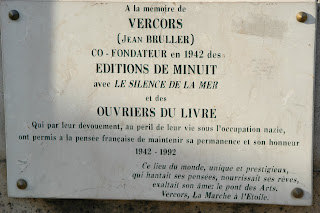
 Occupation. In Cantal with Berndette, we stop in the village church of Lacappelle del Fraisse where I see the children’s uncles listed on the wall plaque. Everywhere there are war memorials, but here in St. Mâlo I find the list of civilian deaths longer than the regular army or the resistance. In Saint Pois as well there are civilian deaths listed as victims of the war, across the nave from the list of military dead.
 Both these coastal towns bore the heavy blows of the invasion.
Outside Saint Pois along a remote country road, we find the Brittany American Cemetery, one of many that dot the countryside, carefully groomed and maintained, mute
 testimony to the honor in which
 they are held. Listening in this place, the accents I hear range from Texas to Boston to Georgia. These young Hoosiers heard and answered the call of their country. Their sacrifice is not forgotten and continues to


 uphold the sense of brotherhood that the French people express for Americans. There is no politics in that sentiment, only a recognition of having shared the brutal agony that bought our freedom.


 The names of city streets are a good example. Here is a street named for a Breton poet. In the Reuilly suburb of Paris we traversed this street named for a local firefighter who gave his life fighting a neighborhood fire.
Roads are labeled more
 prominently by the next town than by the road number; during the Occupation in the 1940s, residents in France (and England as well, in anticipation of an invasion) moved or removed the signs to confuse the enemy.
French towns welcome visitors and note their boundaries with a pair of signs, coming and going. Notice that the name of this village in Cantal, near Aurillac, is in Occitan, not French. The universal use of
 French dates to World War I, when the Alsacian, the Breton, the Provençal, and the southern boys who spoke Occitan gathered in one army. Those that went home spoke French, and after the war, government activities and education nationwide were conducted in French. This sign is written both in Breton and in French. The regional languages are rarely spoken in the home as a native language, but are still available to be learned in schools.


 In the country, addresses are not numbered on roads but named. Cavalhac is the name of the farm of the Ginioux family near LaCapelle del Fraisse which is in the Cantal. The nearest city of Aurillac is nestled in the river valley, a charming place.
 The coastal path that follows the Breton coast is marked with various stripes of color denoting a lengthy hiking path or an easy local trail. After Jean-Jacques explained the system to me, I began to see the little stripes on posts and trees, marking turns and intersections.
 This is not really a street sign, but rather a parking sign that I found delightful in its guilt trip: if you take my parking place, take my handicap, too. That almost amounts to a curse, doesn’t it? Do you suppose it is more effective than the chair alone?
Building signs
 often have a story to tell. In Sevilla I was astounded to find the location of the original Carmen. Her tobacco factory still stands, with the name a part of the art that the casual visitor might pass without seeing. In Paris, the Orsay museum tells the story of its role post-war in the care of the survivors of the prisoner of war camps and the death camps of Eastern Europe. At the time, this building was the central train station in Paris; from April to August of 1945 when the gaunt and nearly dead victims of the camps arrived, they were simply too ill to go any farther, so the station was converted to a hospital. It became the largest repatriation center in the country. It is a solemn testimony to those who so suffered that this moment in the Orsay history be publicly remembered, even as the building takes on such a completely different role as the impressionist art museum.
 This historical marker in the park on the far east side of Paris seems almost to miss the good old days when the neighborhood had a more illustrious life. A garden in the heart of the Left Bank honors Saint Catherine Labouré, the nun whose vision of the Virgin Mary led her to create the Miraculous Medal. Saint Catherine is enshrined in the adjoining chapel, which is daily thronged with pilgrims.
 Store owners use this common sign to reassure clients that they are permitted to browse in the boutique, as the custom for small shops is that clients do not enter until they have selected their purchases from the window display and are ready to buy.

 Governments have used signs to persuade the populace: this British poster from the 1940s uses the heroic and sacrificial leadership of Joan of Arc to inspire the women to save Britain. This sign in Hemmerde, Christian’s home, celebrates the communities’ long life.

 In today’s Paris, the mayor’s office reminds citizens of their civic duty by commending them for their solidarity and urging them to aid their neighbors, an inspired means to urge a diverse populace to seek common ground. This
 notice in the Saint Denis cathedral on the far
 northeast side of Paris asks visitors and parishioners alike to give generously of what they have, to care for each other. The prominent displays of this hostage taken in Columbia and her status as an adopted Parisian also asks the populace to be globally aware, reminding us that we are all citizens of the world. What a commendable way to inspire international collaboration!
Along the Breton coast there is a windswept cliff with a small

 stone cabin, once a key coastal defense position. This poignant sign asks passersby to remember the role of this place in protecting the populace from the all too frequent threat from the sea. The name of this boat is Son of the Wind, a delightful irony as Jean-Jacques had just told me as me walked along the quay leaning into the wind of a time that he had been blown horizontal, hanging on to some rail for dear life.
 On our trip to Finistère, Jean and Marie-Claire and I stopped to read this sign on the monument marking the site of the devastating shipwreck of the Amoco Cadiz in 1974. The ship spilled crude oil that became a black tide for Brittany, whose economy depends heavily on fishing and tourism, both of which were virtually eliminated for a costly period of time. The cost to sea life was greater, killing birds and sea animals in appalling numbers.
 This memorial on the point above the little port beside the Val-André commemorates Breton sailors lost at sea. Briac is doing his best to explain what that means to a child of this land bounded by the seas.


In the cathedral dedicated to her memory, built high on the hill above her native village, Joan of Arc’s final words are written under the murals that depict her life. “I declare once again, my voices were from God, no, no, my voices were not mistaken... Jesus! Jesus!”

 And at the entrance to the chapel dedicated to the soldiers who gave their lives for France are Joan’s words to her countrymen on behalf of those patriots: “Build chapels to pray for those who gave their lives for their country.”
Her home town of Domrémy has been renamed in her honor, using her nickname, La Pucelle. In the church where she first heard the voices of the saints, the statue of Ste Marguérite has been removed due to a near theft; its location is now marked with this plaque.


It is
 the signs that bestow honor on those who lay down their life for their country that speak most powerfully to me. They appear frequently in Brittany, Normandy, Paris, Lyon. This plaque in Lyon honors the memory of the 300 students who died in the resistance; another marks the place of the execution of 7 young men, young Jews. In Ploubelay, near Saint Mâlo, this sign marks the spot of another French soldier’s death, August 6, 1944, but the plaza is named for an American who died here August 7. In a carefully selected proximity to these signs is the notice of the town’s sister city, in Germany.


In Paris this bridge honors those who printed and distributed the clandestine press during the

 Occupation. In Cantal with Berndette, we stop in the village church of Lacappelle del Fraisse where I see the children’s uncles listed on the wall plaque. Everywhere there are war memorials, but here in St. Mâlo I find the list of civilian deaths longer than the regular army or the resistance. In Saint Pois as well there are civilian deaths listed as victims of the war, across the nave from the list of military dead.
 Both these coastal towns bore the heavy blows of the invasion.
Outside Saint Pois along a remote country road, we find the Brittany American Cemetery, one of many that dot the countryside, carefully groomed and maintained, mute
 testimony to the honor in which
 they are held. Listening in this place, the accents I hear range from Texas to Boston to Georgia. These young Hoosiers heard and answered the call of their country. Their sacrifice is not forgotten and continues to


 uphold the sense of brotherhood that the French people express for Americans. There is no politics in that sentiment, only a recognition of having shared the brutal agony that bought our freedom.


Subscribe to:
Posts (Atom)

